

Government capacity building · Consulting · Diagnostics
Better decisions for
governments. project teams. donors. institutions. leaders.
Risalat Consultants International works alongside governments, public agencies and project teams, supporting delivery on the ground, then building lasting capacity in institutions through diagnostics and applied learning in 80+ cities. Since 2011.
Risalat at a glance
Selected engagements with governments and partners
Source: Risalat portfolio
Official development assistance, 2025
Largest donors · change vs. 2024
Preliminary data; OECD projects a further −5.8% in 2026. Source: OECD, April 2026
Climate adaptation finance gap
International public finance to developing countries · per year
Source: UNEP Adaptation Gap Report 2025
Jobs exposed to AI
Share of employment, by country group
“About half” refers to exposed jobs in advanced economies. Source: IMF, 2024
Public procurement, share of GDP
Same spending, very different systems
2018 data. Source: World Bank, 2020
Government capacity building, from project to practice.
Government capacity building that sticks. We are not a course catalogue. We work where development happens, with ministries, agencies and project teams, and then move what works into the hands of the institutions that must sustain it.
What brings you to Risalat today?
Choose who you are, we’ll show you the fastest way in.
Strengthen institutions that deliver.
Assess capacity, governance and controls, then build the skills to close the gaps.
Keep your project on track.
Spot delivery risks early, fix procurement bottlenecks and meet safeguard requirements.
Evidence you can rely on.
Commission research, evaluations and consultant-led assessments for your programmes.
Spend the training budget where it counts.
Identify priority skill gaps, then match them to programmes, open, in-house or online.
Partner on the next generation of GovTech.
Bring your technology to public institutions, with the institutional know-how to make it stick.
Where institutional know-how meets technology
Technology succeeds in the public sector only when institutions are ready to use it. We bring 15 years of work with ministries, PIUs and development programmes. We are looking for technology and innovation partners to co-build what comes next.
Click a track to see it in action.
AI reads your answers and evidence, then explains why each gap matters.
Analytics that flag risk, delay and integrity issues before they become audit findings.
Applied learning paths: every module ends with something used at work.
Seven tools. Ten minutes. One clear picture.
Hover or tap a card to see what you get. Every tool gives instant scores, priority gaps and the support that fits, the evidence base for government capacity building.
Project Health Check
What is putting delivery at risk?
Project Health Check
- Score per delivery area
- Main risks in priority order
- Print-ready for your director
Training Needs
Which training should we ask for?
Procurement Maturity
Where do we strengthen first?
Institutional Capacity
Are we ready for our mandate?
Digital Readiness
Are we ready to digitize?
M&E and MEAL
Is our evidence decision-ready?
Governance & Audit
Where are we exposed?
Find your tool
Start from your challenge, we’ll point you to the right diagnostic.
Tip: results can be saved as PDF and shared with your director.
The big picture, in four numbers
Hover or tap a card to see what it means for your institution.
of global GDP is spent through public procurement, about $11 trillion a year.
Source: World Bank, 2020 (2018 data)
Every point of procurement efficiency frees real money for services. Where does your unit stand?
Procurement Maturity →annual SDG investment gap in developing countries, up from $2.5T in 2015.
Source: UNCTAD SDG Investment Trends Monitor
Funds flow to institutions that can plan, deliver and prove results.
M&E and MEAL →people worldwide lack official proof of identity, about 1 in 10.
Source: World Bank ID4D
Digital public services only work when the foundations | ID, data, systems, are in place.
Digital Readiness →a year needed by 2030 for climate action in emerging and developing economies (excluding China).
Source: Independent High-Level Expert Group on Climate Finance, 2022
Access to climate finance depends on strong proposals and the capacity to manage funds.
Climate programmes →Training often remains theoretical, detached from execution. Consulting often ends with reports, not responsibility. We work in the space between.
Learning without follow-through
- Generic content
- Skills not applied at work
Assess → Train → Advise → Implement
- Starts from your real gaps
- Training tied to your systems
- Support until change sticks
Reports without ownership
- Recommendations on paper
- Capacity leaves with consultants
What’s happening right now
Live headlines from the development world, next to the latest practical analysis from Risalat.
Global development news · UN News
Latest from Risalat InsightsScroll for more →
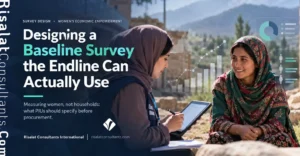
- Designing a Baseline Survey the Endline Can Actually Use
 Most baseline surveys measure households when the project targets women. The error surfaces at endline, when nothing can be done about it. What baseline survey design has to settle before procurement.
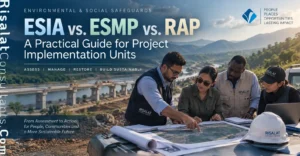
 - ESIA vs. ESMP vs. RAP: A Practical Guide for Project Implementation UnitsESIA, ESMP and RAP are among the most important environmental and social instruments used in development projects, but they serve different purposes. This practical guide explains the differences, how the instruments connect, when each may be required, and what Project Implementation Units should check to move from safeguard documentation to effective implementation.
- Livelihood Restoration Under World Bank ESS5Livelihood restoration under World Bank ESS5 goes far beyond compensation. Explore how governments and project teams can address economic displacement, restore sustainable livelihoods, strengthen institutional capacity, and achieve lasting recovery for project-affected communities.
- Why Government Procurement Reforms Rarely Reduce CorruptionGovernment procurement reforms often promise greater transparency and accountability, yet corruption continues to undermine public spending worldwide. Discover why procurement reforms fail, the institutional and political barriers behind persistent corruption, and the practical strategies governments can use to build stronger, more transparent, and sustainable procurement systems.
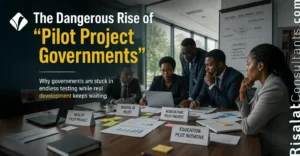
- The Dangerous Rise of Pilot Project GovernmentsThe pilot project government model leaves many reforms trapped in endless testing cycles. Learn why government pilot projects fail to scale, how donor-funded initiatives struggle to achieve sustainability, and what public sector leaders can do to strengthen institutional capacity, secure long-term financing, and move from pilot programs to lasting national implementation.
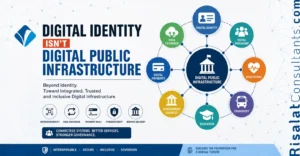
- Why Digital Identity Isn’t Digital Public InfrastructureDigital identity alone is not enough to build effective digital public infrastructure. Governments need interoperable systems, governance frameworks, payment rails, and integrated service platforms to deliver secure, scalable, and citizen-centered digital services.
- Customs Modernization and Border Management Reform for GovernmentsCustoms modernization and border management reform are transforming how governments facilitate trade, strengthen revenue collection, and secure borders. This article explores practical frameworks, automation strategies, and institutional reforms that enable faster, smarter, and more efficient customs systems.
- From Fragmented Data to Smart Decisions: Designing National Data Systems for GovernmentsGovernments generate vast amounts of data, yet much of it remains fragmented and underused. National data systems provide a practical path to connect information across agencies, strengthen governance, and turn existing data into actionable insights. By improving integration, analytics, and institutional capacity, governments can make faster, smarter, and more effective decisions that directly improve public service delivery and policy outcomes.
- Digital Burnout: The Real Price of Your ‘Always On’ Work LifeDigital burnout is not a personal weakness, it’s a system design problem. Constant connectivity erodes focus, empathy, and the ability to do meaningful work. At the same time, high performers face a “competence tax,” where reliability leads to more demands, interruptions, and hidden career stagnation.
- How to Create Smart Municipal Budgets That Drive City GrowthSmart municipal budgeting enables cities to transform limited resources into strategic investments for sustainable growth. By combining data-driven decision-making, innovative financing, and strong governance frameworks, municipalities can improve service delivery, unlock infrastructure funding, and build financially resilient urban systems.






32 categories. 80+ cities. Or your own office.
Government capacity building programmes in global hubs, exclusive courses for your team, or on-the-job coaching where you work.
Trusted across the development ecosystem
Governments, public agencies, project teams, UN agencies, NGOs and companies, from Pacific transport authorities to peacekeeping missions.
Leadership, projects & performance
Short talks on leading through uncertainty, project delivery and strategy.
YouTube channel →
Why Smart Professionals Struggle When Everything Gets Uncertain

The Silence That Cost Everything: Leadership & Project Failure

Explore the Ways Towards Your Blue Ocean with Risalat
In participants’ own words
“I really enjoyed and fully satisfied with the results of the Strategic Performance M&E program I attended in Singapore.”
“The arrangement was excellent and professional. It was beyond our expectation.”
“We had an excellent experience with Risalat while attending the Disaster Risk Reduction workshop in Phnom Penh.”
“Program was excellent and met my expectations in high terms, the facilities and logistical arrangement were awesome.”
“Wonderful service, quality of accuracy and every detail counted.”
“Learned many new implementable factors, worth to join and travel in such a program.”
“I really enjoyed and fully satisfied with the results of the Strategic Performance M&E program I attended in Singapore.”
“The arrangement was excellent and professional. It was beyond our expectation.”
“We had an excellent experience with Risalat while attending the Disaster Risk Reduction workshop in Phnom Penh.”
“Program was excellent and met my expectations in high terms, the facilities and logistical arrangement were awesome.”
“Wonderful service, quality of accuracy and every detail counted.”
“Learned many new implementable factors, worth to join and travel in such a program.”
Government capacity building: questions organisations ask us
Quick answers about government capacity building, who we are, how we work and how to start.
What does Risalat Consultants International do?
Risalat Consultants International (RCI) is a consulting firm founded in 2011 that specialises in government capacity building. We work with governments, project teams, development partners, NGOs and companies on diagnostics, advisory support and applied learning in procurement, project and contract management, monitoring and evaluation, governance, environmental and social safeguards, climate, digital government and leadership.
What does government capacity building with Risalat look like?
Every government capacity building engagement starts with evidence, a diagnostic of where the institution stands, then combines advisory support with applied learning tied to the team’s real systems, so the capacity stays after we leave.
Is Risalat only a training provider?
No. We work where delivery happens, alongside ministries, agencies and project implementation units, and then transfer what works to institutions through applied, tailored learning, so capability stays after the assignment ends.
Who does Risalat work with?
Ministries and public agencies, project implementation units, UN and international agencies, NGOs and humanitarian organisations, and private-sector companies.
Where are Risalat programmes delivered?
In 80+ cities across six continents, in-house at your organisation, or online. Browse 32 programme categories.
Are the Risalat diagnostic tools free?
Yes. Seven free self-assessments, including a Training Needs Assessment and a Project Health Check, give instant scores and priority gaps in about ten minutes, with no sign-up. Open the Diagnostic Centre.
How can we request support or an in-house programme?
Share your challenge with us and we will assemble the right expertise. Contact Risalat.
Tell us the challenge. We’ll assemble the expertise.
Preparing a new initiative, strengthening a project, commissioning research or building your team’s capability, start the conversation today.